Stem Cell Hair Transplant vs. Traditional FUE: A Regenerative Surgeon’s Guide
Every week in my clinic, I meet patients who have done their homework. They’ve watched the videos, read the forums, and they come to me with a particular question: “Doctor, should I stick with the standard FUE, or is the new Stem Cell method right for me?”
It is a valid question. The landscape of hair restoration has undergone a dramatic shift. We are no longer just “moving hair from point A to point B.” We are now in the era of biology, regeneration, and cellular healing.
As a surgeon, my goal isn’t just to cover a bald spot; it is to restore your confidence with the most medically sound approach available. Today, I would like to share my perspective on the two most widely discussed procedures in our field: the Stem Cell Hair Transplant in Lahore and the traditional Follicular Unit Extraction (FUE).
My aim here is transparency. I want to help you understand not just the marketing behind these terms, but the medical reality, so you can make an informed decision about your body and your future.
The Gold Standard: Understanding Traditional FUE
Before we dive into regenerative medicine, we must respect the foundation of modern hair surgery: FUE (Follicular Unit Extraction). For years, this has been the procedure I perform most frequently, and for good reason.
In a traditional FUE procedure, I manually extract individual hair follicles from the donor area (usually the back of the head) and implant them into the thinning or balding areas. It is precise, effective, and leaves minimal scarring compared to the older “strip” methods.
Why FUE Still Works
- Permanence: The hair we move is genetically resistant to balding. Once it takes root, it stays.
- Predictability: We know exactly what to expect regarding yield and coverage.
However, FUE has a hard biological limit: Donor Supply. I can only move what you already have. If your donor area is weak or if the balding area is extensive, traditional FUE alone might not provide the density you dream of. This is where the conversation shifts to regenerative approaches.
What Is a Stem Cell Hair Transplant?
The term “Stem Cell Hair Transplant” is often misunderstood. Patients sometimes ask me if we can “clone” their hair in a lab and create an unlimited supply. While science is moving in that direction, in 2026, clinical “Stem Cell Hair Transplants” usually refer to Regenerative-Assisted FUE or Autologous Micrografting.
When I perform a Stem Cell Hair Transplant in Lahore, I am not just moving hair; I am using your body’s own potent biological material to boost the survival of those hairs and wake up dormant follicles.
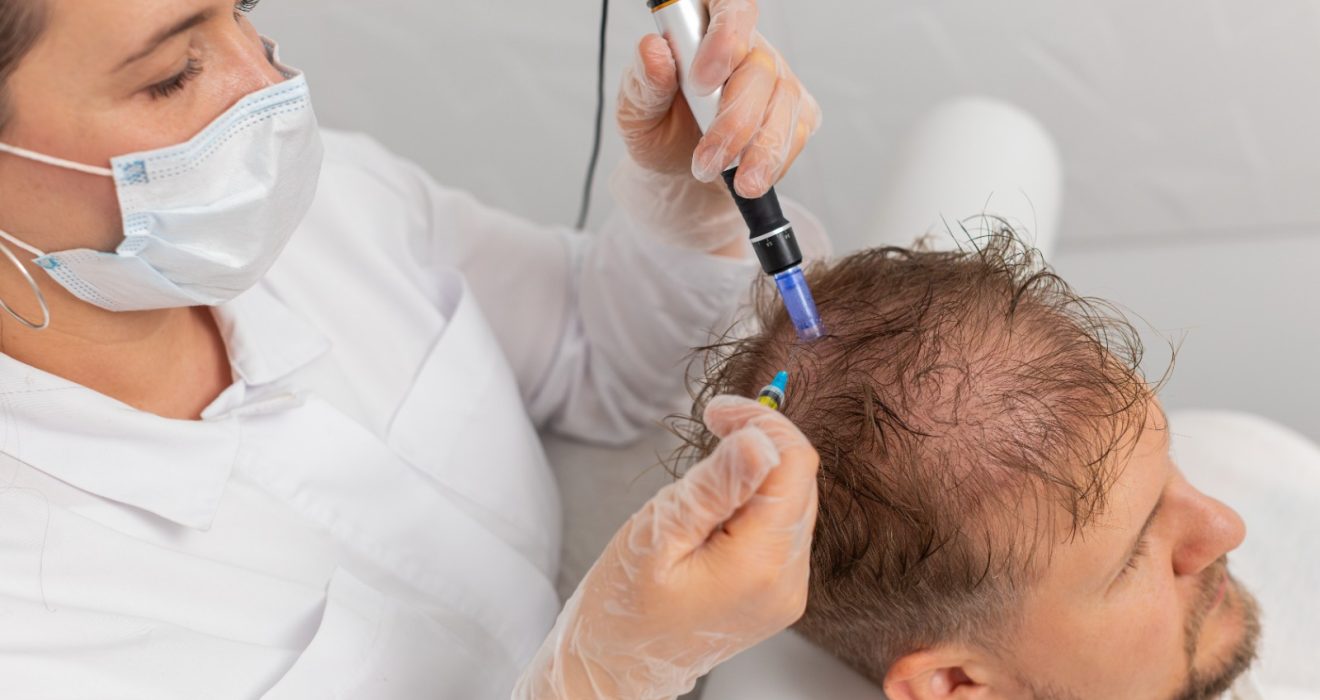
We typically harvest a small sample of tissue rich in progenitor cells (often from behind the ear), process it to isolate the regenerative elements, and inject this “liquid gold” back into the scalp. This creates a fertile environment for the new grafts and can even thicken existing, thinning hair that FUE alone wouldn’t touch.
The Core Difference: Regenerative Hair Restoration vs. Replacement
The simplest way I explain this to my patients is with a gardening analogy.
Traditional FUE is planting seeds. We take a healthy seed (follicle) and plant it in the soil (scalp). If the soil is dry or poor, the seed might struggle.
Regenerative hair restoration is fertilizing the soil and planting the seeds. We are improving the vascularization (blood flow), reducing inflammation, and signaling your scalp to enter a “growth phase.”
This distinction is critical because hair loss isn’t just about missing hair; it’s often about a scalp environment that has become hostile to hair growth due to DHT (dihydrotestosterone) and aging.
Exosomes: The Next Frontier in Pakistan
Alongside stem cells, I have seen a massive surge in interest regarding Exosome hair therapy in Pakistan. While stem cells are the “architects” of the body, exosomes are the “messengers.” They are tiny vesicles that carry instructions from cell to cell, telling dormant hair follicles to “wake up” and start growing again.
In my practice, I often use exosome therapy as a powerful adjunct to surgery. For younger patients who aren’t ready for a transplant yet, or for women with diffuse thinning, exosomes can be a game-changer. They don’t require surgical harvesting of tissue, making them a less invasive option with zero downtime.
Comparison: Stem Cell vs. Traditional FUE
To help you decide, let’s look at how these compare in clinical practice.
1. The Candidates
- Traditional FUE: Best for patients with stable hair loss and a good donor supply who want a permanent structural change to their hairline.
- Stem Cell / Regenerative FUE: Ideal for patients with diffuse thinning, weaker donor areas, or those who want to maximize the density of their transplant. It is also excellent for younger patients, where we want to slow down future loss.
2. The Procedure Time
- Traditional FUE: A labor-intensive day, usually 6–8 hours depending on graft count.
- Stem Cell FUE: Adds about 30–45 minutes to the standard surgery time for the harvesting and processing of the regenerative solution.
3. Recovery and Growth
- Traditional FUE: Scabs usually fall off in 10 days. New growth starts around month 3 or 4.
- Stem Cell FUE: In my experience, the healing is often faster. The anti-inflammatory properties of the stem cells reduce redness and swelling. Interestingly, I often observe that the “shock loss” (temporary shedding after surgery) is less severe in regenerative cases.
Hair Transplant Cost Lahore 2026: A Transparent Look
I believe in being upfront about the investment required. As we analyze hair transplant cost in Lahore in 2026, we see a clear divergence based on the technology used.
Traditional FUE has become more accessible, but quality varies wildly. A high-quality FUE procedure requires skilled technicians and hygiene standards that cannot be compromised.
Stem Cell Hair Transplants are inherently more expensive. Why?
- Technology: The kits used to isolate stem cells or exosomes are costly and usually imported.
- Expertise: It requires a surgeon who understands cellular biology, not just hair mechanics.
However, I always tell my patients: Value is measured in longevity, not just the upfront price. If a regenerative approach prevents you from needing a second surgery in 5 years, it is the more economical choice in the long run.
My Philosophy: The “Dr. Badie Idris Hair Transplant” Approach
When you come to me for a Dr. Badie Idris hair transplant, I don’t just sell you a number of grafts. I look at your age, your family history, and the quality of your existing hair.
I have turned away patients requesting 4,000 grafts via FUE because I knew it would over-harvest their donor area. Instead, I might recommend a smaller FUE session combined with regenerative therapy to thicken what they already have.
Safety is paramount. In the aesthetic world, “more” is not always “better.” “Better” is better. A natural, dense result that respects your physiology is always my priority.
Frequently Asked Questions (FAQs)
Q: Is a Stem Cell Hair Transplant painful?
No more than a regular dental procedure. We use local anesthesia. The harvesting of the tissue for stem cells is very quick and heals almost invisibly.
Q: Can stem cells regrow hair on a completely bald head?
No. If the follicle is dead and gone (shiny bald skin), stem cells cannot bring it back. You need a transplant (FUE) to put hair there. Stem cells help existing hairs and improve the survival of transplanted hairs.
Q: How long do the results last?
Transplanted hair is permanent. However, your native hair is still subject to aging. This is why I often suggest maintenance therapies to protect your investment.
Q: Is Exosome therapy safe?
Yes, provided the exosomes are sourced from reputable, clinically grade labs. In my clinic, we adhere to strict safety protocols to ensure purity and potency.
Final Thoughts: Which Path is Yours?
Choosing between Traditional FUE and a Stem Cell Hair Transplant isn’t about choosing “good vs. bad.” It is about choosing “good vs. optimized.”
If you have a strong donor area and specific balding patches, Traditional FUE remains a fantastic, life-changing solution. But if you are looking to maximize every single follicle, speed up healing, and treat the underlying health of your scalp, the regenerative route offers benefits that surgery alone cannot match.
The best way to know? Let’s look at your scalp together.
Are you ready to restore not just your hair, but your confidence?
Book a consultation with me today. Let’s assess your unique case and design a restoration plan that lasts a lifetime.
Contact Us: 0303-4445272